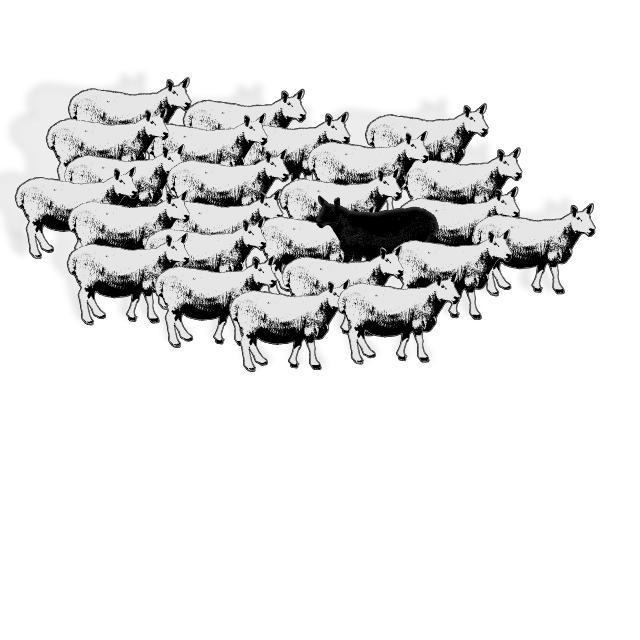

It would make sense that I’m not a fan of AI copywriting. I’m a copywriter myself and a messaging coach. Brands use AI not to pay people like me.
And that’s a fair point.
But that’s not what I want to talk about here. Though how someone thought using the amassed work of other people to avoid paying them was ethical honestly still boggles me. But that’s a story for another day.
Here’s what you might be missing in this one.
AI’s likely not taking my job
See, people who want to save on copy by using AI are probably not my target audience, anyway.
But I notice something you perhaps don’t see if you’re not someone doing creative work yourself. (Which btw is fine, not everyone should be a creative.)
Let me give you an example first.
Say you like a sculptor’s work. But you really don’t want to pay to have their sculptures at home. So you buy a 3D printer. And you use it to print copies of their work (which, say, they make in stone or wood). And you print them in plastic. Now, you can have one in every room. (Or you can buy them from Temu, same thing.)
This is what AI copy sometimes reads like to me.
It’s the same structures copied everywhere – because AI will use the most common ones. Making your text read like a cheap rendition. And resulting in the infamous “It’s not about X, it’s about Y” literally everywhere.
It’s not a problem with repetitions
See, a seasoned writer uses repetition and other stylistic figures and literary devices with intention. (At least, most of the time.)
AI has no intention. It has no taste. No original style. It puts together blocks – words and phrases – to create a piece of text. Which is fine – until every brand uses it and ends up with website copy, articles, LinkedIn posts and online ads that read the same, stuffed into the same writing frameworks.
Deja vu much?
Because that’s what it feels like reading another InMail or long-form sales page.
I’ve already read that somewhere. Multiple times. What even is this?
The only thing I remember from the dozens of content pieces is not your message. Not your unique value proposition or differentiator. Not even what you’re trying to sell to me.
“The problem is not X. The problem is Y.”
Ringing in my ears.
That’s my takeaway. And for the record, I don’t even remember the X or the Y. Truly.
Now, I appreciate that I’m a writer myself and I’m more sensitive to language in general. But I can’t be the only one becoming blind to the same thing I see over and over again.
I mean, try getting your email opened in a crowded inbox by writing what everyone else does. Or your cold email replied to – when it doesn’t even get read.
So, it might be me b*tching about AI writing. But it’s also actual links that don’t get clicked, ignored messages, ads people scroll past.
You know what this is really about?
Not throwing the baby out with the bath water. Yes, you can increase your input and lower your marketing costs by using AI instead of paying someone whose job is to write. But how is that working out for you in the long run? How’s that helping you build your unique brand voice? How does your message set you apart from your competitors the moment someone lands on your website?
And for the record, yes, brands used the same copy on their websites across industries even before AI. And yes, that still made them indistinguishable from their competitors.
So, what do you propose, Karolina?
Great question, thank you.
I propose looking for your own voice. You can use AI to write things (I sometimes do it too – but always heavily edit anything it spills out. Btw, no AI was involved in this piece – it’s powered by pure frustration, the best fuel for a writer. 😀)
Just don’t blindly take anything it puts out and then send it to your prospects. Or at least, create a style guide for your brand that AI can use. And then still edit it, so every content piece you put out there isn’t structured the same way as every other one on the Internet.
Be somebody, not just anybody. (Help 🎶)