In short, it’s asking the right questions and noting down the important stuff that comes up in team conversations during the workshops.
A workshop I ran with a team at a creative agency in Berlin
I did come across an issue, though. Well, maybe not an issue, but an observation.
Some brands had more homework to do. They didn’t know their market positioning (which was the easy part, and I’ve come to include in the workshop), and sometimes even the fundamental value of what they were trying to sell.
Because the role of the unique value proposition is not to produce something in a workshop that will differentiate your brand from your competitors, when it’s not there. And I often found that was what brands expected. (Worst case scenario, they expected it from the copywriter writing the homepage headline – and I’ve been in that role a lot, too.)
It’s to select the thing you’re going to focus on in your messaging – but it needs to be there in the first place. Your product or your service needs to be able to provide it. And you need to know that it does.
Now, let’s take a look at it from a broader communications perspective (and not just marketing comms).
The basics of communication
I don’t mean for this article to be another rendition of the UVP theory – you’ll find a lot of it online (or you could ask whichever LLM you use to figure out this kind of stuff).
I want to talk about what happens when real people offer products and services to other real people. Because, technically, that’s what’s going on (at least, for now, anyway. Bots writing for bots is a thing, you know.)
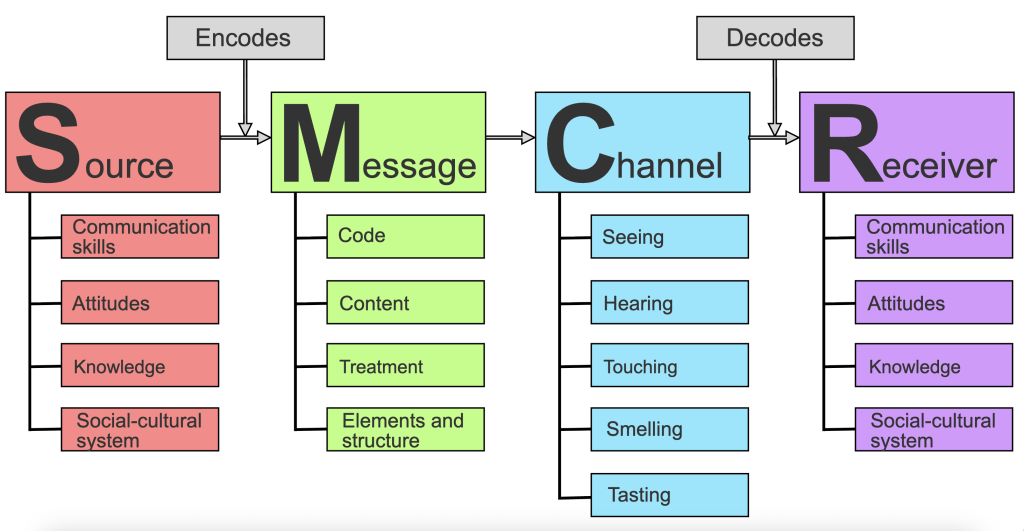
There’s this decades-old basic model of communication, that looks like this:
David Berlo’s model of communication. Source: Wikipedia
(Actually, there are way more versions of communication models, but let me use this one for now.)
Now, when you’re trying to market a product or service, you have your target audience – the receiver. With their demographics and – much more importantly – their needs, wants, pains, and dreams. In other words, your product or service needs to address something they want or need in their lives.
When you talk about your product or service, I like to think about two aspects of your message:
the what – so, how your product or service is solving a problem or a need
and the how – i.e., your voice and personality.
(I’m purposefully omitting the channel for now.)
The former will help you target the people who need your product or service.
The latter will narrow down that group to the people who are actually your target audience – the ones who speak the same language and have similar values.
In other words, it’s great that you’re focusing your message on the receiver. But you can’t take the sender out of the equation entirely, either.
In yet other words:
There is no message without the sender.
But why would I want to narrow down my target audience?
Because in real life, you’re not friends with everyone. You can try, but it will likely be exhausting. Because by catering to everyone, you can’t really stay true to yourself.
And when you’re a brand – and really, any brand – you can’t really stand out from the competition if you’re not thinking about both those elements.
It’s enough to look at the SaaS world. But it also works when you’re a solo service provider (like me). Your software platform might tick all the boxes for the so-called user. But they probably also have dozens of other similar software platforms to choose from.
And even if you’re innovating with something never done before (which, let’s face it, you’re probably not), others will catch up before you know it.
Yes, you can compete on price – but that’s also until someone comes up with a better offer.
What you can’t really be beat on is who you are.
The uniqueness of unique value propositions
Even if your UVP targets a true need, that need is not exclusive to your product or brand. The recipient owns it. And anyone can target it, too, so, it’s not really unique in that sense.
But when you bring your distinct personality and voice to it – as a brand or as a professional, because this really applies to any product or service – this is when you really stand out.
It’s true for SaaS platforms, B2B tech services, even consumer products. And it’s even more true (if that’s even possible) when you’re a freelancer, a solo service provider, or even an expert looking for full-time employment.
And yes, we can talk all day about how the value is in the product/service, and it’s the professional thing to do.
But these days, I truly believe that it’s not enough anymore. And I really don’t mean you need to be eccentric, alternative, loud, or whatever.
If you’re “you” – whatever that is – your crowd will find you (if you put yourself out there, I mean).
And if you’re “for everyone”, yes, maybe everyone will find you, but that doesn’t mean they’ll stay. Because you’ll be one of many they’re considering. And if they don’t resonate with something you say or how you say it, they’ll bounce. (And possibly even forget you.)
So, who are the right people for your product or service?
And how do you let them know that they’ve actually found what they’ve been looking for?